Get in touch
* Your personal information is securely protected and will only be used for business communication purposes.

Semi Electric vs Fully Electric Stacker Guide for Growing Warehouse Teams is written for warehouse teams that have moved beyond occasional pallet handling and now need equipment that matches a growing daily workload. Semi electric stackers often enter the site because they keep cost low while reducing some manual lifting effort. Fully electric stackers enter the conversation later, when labor time, cycle count, and aisle congestion begin to make manual travel and repetitive handling feel expensive. The challenge is knowing when the upgrade is operationally justified.
A useful comparison starts with the route and the repetition level. If the warehouse only performs occasional lifts and short moves, a semi electric unit may still deliver enough value. If the team is lifting, repositioning, and traveling through the aisle all day, full electric drive can change both productivity and fatigue. Buyers comparing the walkie electric stacker CDD-15, walkie electric stacker CDD-20, stand-on electric stacker CZD-15, and stand-on electric stacker CZD-20 should frame the decision around cycle intensity, not just purchase price.
Semi electric stackers reduce manual lifting effort, but they still leave more of the travel and positioning burden with the operator. That can be perfectly acceptable in low-frequency work, simple backroom storage, or smaller facilities where the same machine is not moving pallets constantly. Fully electric stackers shift more of that effort into the truck itself, which becomes valuable once the work pattern is repetitive enough that walking, pulling, and re-approaching start to slow the team down.
From a management point of view, the question is not whether either truck can lift the pallet. The question is how much operator energy and time the route consumes each day. Guidance from OSHA powered industrial trucks guidance, OSHA 1910.178 standard, and CCOHS manual materials handling is helpful because it ties equipment choice back to ergonomics, safe movement, and task design rather than focusing only on the purchase invoice.
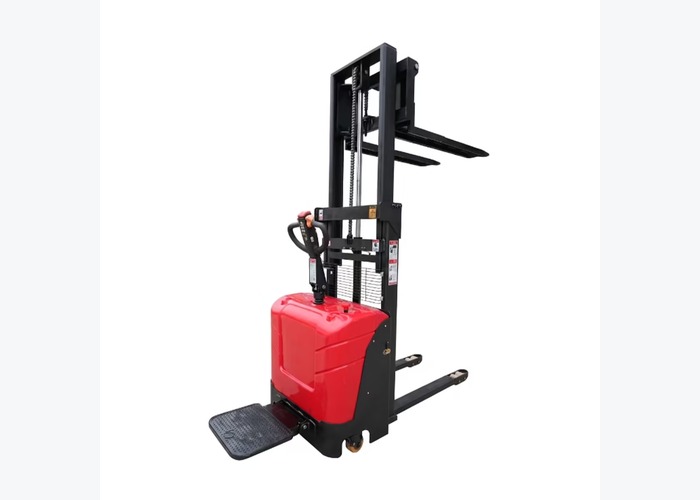
Semi electric stackers are often a practical fit for modest cycle counts, short travel distances, and facilities that need an economical way to place pallets at height without stepping into a more automated material flow. Small workshops, retail backrooms, light receiving areas, and lower-volume production support spaces can all benefit when the duty cycle is controlled and the operator is not repeating the same movement continuously for a full shift.
In those situations, the semi electric option may offer enough lift help to improve safety and reduce the most awkward manual handling while keeping acquisition cost lower. The mistake happens when managers keep the same tool in place after the route has evolved into something faster, denser, or more repetitive than the original buying case.
Fully electric stackers become more attractive when the warehouse depends on repeated lift cycles, longer aisle travel, or more consistent pallet placement at height. Once the operator is moving pallets throughout the day, powered travel starts saving more than time alone. It also saves concentration and physical effort, which helps maintain better execution later in the shift. That matters in warehouses where the pace remains steady from receiving through replenishment and storage.
A fully electric stacker also tends to support cleaner workflow in shared aisles because the truck can be controlled more predictably under load. If the site wants to improve repeatability rather than simply survive the workday, powered travel usually becomes easier to justify. In that environment, the stacker is no longer just a lifting tool. It becomes part of the throughput system.
The simplest upgrade signal is cycle count. If the team is lifting only occasionally, semi electric may stay appropriate. If the machine is active through long work windows with frequent load touches, full electric drive usually pays back through smoother travel, less fatigue, and more consistent storage execution. Managers should count lifts per hour during the busiest period, not during the average quiet period, because the busiest hour typically reveals whether the current tool is underpowered for the workflow.
When the count rises, small inefficiencies become expensive quickly. Extra walking, slower acceleration, and repeated repositioning all add friction. Those losses may look minor one pallet at a time, but across a week they can absorb substantial labor capacity. That is when a semi electric stacker starts to feel cheaper at purchase and more expensive in operation.
Both semi electric and fully electric stackers are often chosen because they fit tighter spaces than larger forklifts, but that does not mean all stacker routes feel the same. A compact warehouse with careful rack approach and short travel may manage well with a semi electric machine. A similar warehouse with heavier replenishment flow may need fully electric drive simply because the operator cannot keep repeating the route efficiently by foot.
That is why route mapping should include the farthest travel leg, the tightest turn, and the most frequent rack approach. Internal references such as the stacker category and the broader warehousing and logistics solutions page help frame whether the warehouse is really a low-duty lift task or a growing logistics workflow that now needs a more capable stacker platform.
Powered travel adds clear value, but it also means the team should think seriously about charging routine and shift timing. If the warehouse runs short, predictable work windows, charging is usually easy to manage. If the route is continuous and the stacker is shared across departments, managers need to plan charging access just as carefully as they plan aisle use. Full electric equipment solves one set of labor problems and introduces one set of energy-management responsibilities.
That should not discourage the upgrade. It simply means the buying decision should include break timing, charger location, and how many hours of continuous work the truck must cover before it can be staged again. The best stacker decision is operationally complete, not mechanically partial.
Fatigue rarely appears on a quotation sheet, yet it shapes output every day. A semi electric stacker may look economical until the operator spends the afternoon walking, pulling, correcting, and repositioning loads that a fully electric machine could handle more smoothly. As fatigue rises, placement accuracy falls, pace slows, and avoidable contact events become more likely. The equipment decision therefore affects quality and consistency, not only speed.
For growing teams, repeatability matters because more people are touching the same workflow. A truck that keeps performance more consistent across the shift often becomes easier to schedule and easier to scale. That is one of the strongest reasons warehouses move from entry-level lift support to more complete electric handling.
Semi electric remains the right answer when the workflow is modest, the route is short, and the team values low entry cost over higher daily output. It can be the correct tool for facilities that only need occasional stacking or want a bridge solution before moving into denser storage. The key is honesty about the duty cycle. If managers know the work is light, there is no reason to overbuy.
The problem begins when a light-duty purchase is left in place while the route becomes heavier. At that point, the machine is no longer aligned with the job, and the labor hidden inside that mismatch grows larger every month.
Fully electric stackers become the stronger choice once travel and lift repetition start controlling the day. If operators are spending too much time walking with load, queueing in aisles, or recovering from fatigue later in the shift, powered travel usually becomes an operational upgrade rather than a comfort feature. Warehouses that expect growth should look closely at this threshold because waiting too long often means buying twice.
If the route already feels busy and the storage plan is becoming denser, the stacker decision should support the next stage of growth rather than only the current week. That is why the product comparison should be tied to a realistic six-to-twelve-month workload outlook.
A warehouse usually sees the need for a fully electric stacker before the current tool completely fails. Operators start staging pallets on the floor because lifting and traveling takes too long. Congestion grows near receiving or replenishment points because the machine cannot keep up cleanly with the pace. Supervisors notice that the same operator finishes the first half of the shift comfortably and the second half more slowly. Those are not isolated complaints. They are operating signals that the route has outgrown the equipment level.
When those signals appear, management should quantify them rather than debate them abstractly. Count the extra walking distance, the delayed pallet touches, and the amount of temporary floor staging caused by slower movement. Once those numbers are visible, the economics of moving from semi electric to fully electric usually become much easier to explain and approve.
Even after selecting the right stacker type, small layout changes can raise the return on the equipment. Clearer pallet staging zones, fewer blind aisle obstructions, better rack labeling, and a dedicated charger position all make the truck easier to use well. Those adjustments matter because equipment upgrades are most effective when the surrounding workflow is not fighting them. A better stacker cannot fully compensate for a route that is badly organized.
For that reason, managers should review the warehouse as a complete handling system rather than an isolated equipment decision. If the site improves pallet presentation, removes unnecessary detours, and defines cleaner traffic paths, both semi electric and fully electric stackers will perform better. The difference is that a fully electric machine tends to unlock more value from those improvements once the cycle count is high enough.
That systems view also helps finance teams understand the purchase. The question stops being whether one truck costs more than another and becomes whether the overall warehouse can move pallets with less delay, less strain, and less temporary floor congestion.
Once the team frames the decision that way, the upgrade case usually becomes more concrete and less emotional.
Can a semi electric stacker handle regular warehouse work? Yes, if the cycle count is modest and travel distance stays short. It becomes less attractive when repetitive daily handling grows.
Does fully electric always mean overbuying? No. In higher-cycle warehouses it can be the more economical choice because it reduces labor strain and supports steadier throughput.
Should I decide based only on lift height and capacity? No. Cycle count, walking distance, charging habit, and aisle repetition usually determine the better choice.
Watch a related stacker video here: https://www.youtube.com/watch?v=iAyBfMb0P9k.

Choose a semi electric stacker when the work is light enough that manual travel does not dominate the day. Choose a fully electric stacker when repeated lift-and-travel cycles make labor effort, fatigue, and aisle flow part of the real cost equation. For growing warehouse teams, that threshold arrives earlier than many buyers expect.
If you want a clearer recommendation, send daily cycle count, lift height, travel distance, aisle notes, and growth expectations to contact VARYON for stacker sizing. That gives the VARYON team enough operating detail to recommend the stacker level that fits your actual warehouse rather than just your initial budget.