Get in touch
* Your personal information is securely protected and will only be used for business communication purposes.

Stacker vs Forklift Guide for Lift Height, Aisles, and Daily Workload is for buyers trying to decide whether a compact stacker can handle the warehouse task or whether the job really requires a forklift. These two machines overlap often enough to create confusion, especially in smaller warehouses where budget, aisle space, and pallet weight are all under pressure at the same time. The right answer depends less on labels and more on how the truck is expected to move, lift, and repeat the route.
A stacker such as the walkie stacker CDD-15 or stand-on stacker CZD-15 can be a very effective answer when the workload is compact, the aisle is tight, and the site wants lower acquisition cost with efficient pallet placement. A standard forklift becomes more attractive once travel distance, pallet mass, outdoor exposure, or loading flexibility rise beyond what a stacker naturally handles well. The decision should be made around the route, not around whichever machine looks more familiar.

A stacker is usually optimized for compact pallet handling, tighter aisles, and more defined lift-and-place work. A forklift is usually optimized for broader travel, heavier counterbalanced handling, and more varied route demands. That sounds obvious, but many buying mistakes come from ignoring it. Teams compare the machines as though they were interchangeable because both can lift pallets, even though they are built around different operating patterns.
The better question is what the truck must do repeatedly. If the task is mostly controlled pallet placement inside a tight warehouse zone, the stacker is often the more direct tool. If the task includes longer travel, heavier loads, uneven surfaces, trailer work, or faster mixed-duty movement, the forklift usually starts to justify itself quickly.
A stacker earns its place when the warehouse layout is constrained and the route does not justify a larger truck. Compact machines make sense in narrow storage zones where every turn matters and the site wants to preserve rack density. Guidance from OSHA powered industrial trucks guidance, OSHA 1910.178 standard, and CCOHS manual materials handling is helpful because it connects equipment choice to route ergonomics and safe movement rather than treating aisle fit as a simple measurement exercise.
If the route is dense, a smaller truck can save time by reducing correction and wasted motion at the rack face. In that setting, the stacker is not simply a cheaper substitute. It can actually be the better fit because it aligns with the physical geometry of the warehouse. That is why high-density storage often pushes the decision toward stackers first, especially when loads remain within a controlled range.
A forklift becomes the stronger option when the machine has to cover distance and not just place pallets. Receiving, staging, dock handling, line feeding, and repeated cross-building movement all reward a truck that can travel comfortably under load and adapt to a broader range of tasks. Once the workflow expands beyond compact stacking, the forklift’s flexibility becomes more valuable than the stacker’s tight-space advantage.
This is especially true when the site wants one truck to cover several departments. A stacker can be extremely efficient in its comfort zone, but it is not always the right answer for long travel loops or mixed-surface duties. If supervisors already know the machine will move constantly between zones, the forklift often becomes easier to justify operationally even if the initial budget is higher.
Buyers often focus on lift height because it is easy to see, but height alone does not answer the question. The site should review lift height together with actual load weight, load center, pallet stability, and how frequently the lift happens during the shift. A stacker can work very well when the load is controlled and the route is repetitive. A forklift starts to make more sense when the weight, stability, or handling variety rises.
That is why product selection should connect directly to the real storage task. A walkie solution like the walkie stacker CDD-15 or walkie stacker CDD-20 may be ideal for a smaller footprint and moderate pallet flow. A stand-on option like the stand-on stacker CZD-15 or stand-on stacker CZD-20 extends capability further. But if the workload begins to resemble a broader counterbalance application, the forklift is usually the more natural step.
A stacker often looks attractive because the initial purchase cost is lower. That can be the right call when the duty is genuinely compact and repetitive. The problem begins when buyers stop the calculation there. If the stacker forces slower travel, extra walking, more pallet repositioning, or repeated workarounds in a route that has already grown, the lower entry price may hide a higher operating cost.
A forklift can look more expensive until the team counts the labor it saves on broader movement and mixed handling. This is why smart buyers compare cost against workload rather than invoice alone. The cheapest machine at purchase is not always the least expensive machine in daily use once labor time, congestion, and repeatability are taken seriously.
If the route moves outdoors, crosses threshold plates frequently, or includes rougher surfaces, a forklift usually gains ground quickly. Stackers are typically selected for more controlled warehouse paths. Once the application adds outdoor loading, wider environmental variation, or more demanding ground conditions, the forklift’s broader operating comfort becomes valuable.
That does not mean a stacker can never approach a dock or loading edge. It means the buyer should be cautious about asking it to behave like a general-purpose yard truck. Advice from CCOHS forklift truck safety, HSE lift-truck training guidance, and HSE workplace transport guidance reinforces that route condition matters because load control and travel predictability change with the surface. When the environment broadens, the forklift often becomes the safer long-term fit.
There are many cases where the stacker is the smarter machine even if the business could afford a forklift. Smaller facilities, backroom operations, compact replenishment tasks, and controlled rack work often benefit from the simpler footprint and lower disruption of a stacker. The machine fits the work naturally, and the warehouse does not have to sacrifice storage density or overbuild the route around a larger truck.
In those situations, internal resources such as the stacker category and warehousing and logistics solutions pages are useful because they help the team think in terms of zone fit rather than pure machine status. A stacker is not a lesser answer when the route matches it. It is often the more precise answer because it solves the actual handling problem without carrying unnecessary bulk into the aisle.
Forklifts become more compelling when the route changes frequently during the day. If the same truck unloads, stages, travels, and supports several departments, versatility begins to matter more than narrow-aisle efficiency. That is where the forklift often wins. It can absorb a wider range of assignments without the operation needing to protect it inside one controlled corridor.
This matters for growing businesses because route creep happens gradually. A site may buy equipment for one narrow use case and then slowly ask it to cover more work than planned. Once that happens, the team should stop thinking in terms of whether the stacker can still lift the pallet and start asking whether the truck is still aligned with the actual workflow. If the answer is no, the forklift may be overdue.
Equipment choice is not only about specifications. It is also about what operators can use confidently and repeatably. A machine that looks acceptable on paper can still slow the route if the operator needs constant correction or feels constrained by the truck’s limits. The right comparison therefore includes ease of use, visibility, approach control, and how cleanly the truck fits the day-to-day movement pattern.
That is especially important for teams with mixed experience levels. A stacker may be easier and calmer in a compact aisle task, while a forklift may feel more stable and familiar in broader handling. Neither answer is universal. The best result comes from matching the equipment to the environment so operators spend less effort compensating for the route.
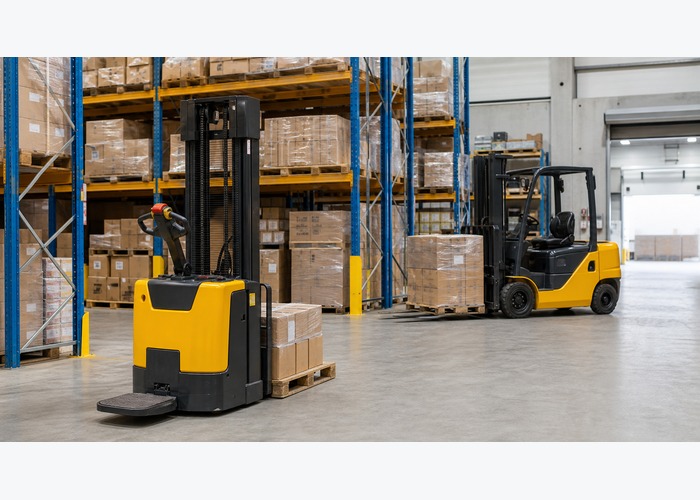
The crossover point usually appears when the warehouse starts asking a compact machine to do broad machine work. Signs include longer travel distance, more frequent queueing, repeated outdoor crossover, heavier pallets, and growing frustration with positioning speed. When those signals appear, management should review the route honestly rather than waiting for a breakdown or a safety event to force the conversation.
The goal is not to prove one machine category superior. The goal is to stop paying for mismatch. If the route is still tight and controlled, the stacker probably remains correct. If the route now behaves like a mixed logistics workflow, the forklift probably deserves serious review. The earlier that crossover is identified, the easier it is to buy once instead of buying twice.
One of the cleanest ways to decide is to map the workflow by zone. Ask where the truck picks up, how far it travels, what it lifts, what surface it crosses, and where it finally places the load. If most zones are compact and predictable, the stacker probably fits. If several zones demand broader travel or handling flexibility, the forklift becomes harder to ignore.
That review also makes supplier conversations more useful because the recommendation can be tied directly to the route. If you share aisle width, lift height, pallet size, travel distance, and growth expectations through contact VARYON for stacker sizing, the VARYON team can recommend whether a stacker, a forklift, or a split-equipment plan makes more operational sense.
Is a stacker always cheaper than a forklift overall? Not always. The purchase price is lower, but a forklift may be more economical if the route needs broader travel and mixed-duty productivity.
When is a stacker the better choice? It is usually the better choice in tighter aisles, controlled pallet work, and compact warehouse zones where broad travel is limited.
What usually pushes the decision toward a forklift? Longer travel, heavier or more varied loads, outdoor exposure, and multi-department flexibility usually push the route toward a forklift.
Watch a related stacker video here: https://www.youtube.com/watch?v=2v7TII46teo.
Choose a stacker when the route is compact, the aisle is valuable, and pallet placement is more important than broad travel flexibility. Choose a forklift when the workload expands into longer movement, heavier mixed duties, or rougher route conditions that demand a wider operating envelope.
If the route sits in the middle, do not force a false yes-or-no answer too early. Many warehouses benefit from defining one compact zone where a stacker works efficiently and another broader zone where forklift-style travel and handling are still required. That kind of zoning decision often protects storage density and labor flow better than asking one machine category to cover every movement equally well.
If you want help making that call, send aisle widths, lift height, pallet weight, travel distance, and growth plans to contact VARYON for stacker sizing. That is the fastest way to judge whether the warehouse needs a stacker, a forklift, or a combination of both.