Get in touch
* Your personal information is securely protected and will only be used for business communication purposes.
Walk through most traditional warehouses and you’ll notice something that costs far more than it looks: empty space. Wide aisles — often 12 to 14 feet across — carved out to accommodate bulky counterbalance forklifts represent square footage you’re paying rent on but never actually using for storage. In high-density operations, that’s not inefficiency. It’s hemorrhaging money.
Electric forklifts already commanded a 69.2% global market share in 2024, surpassing internal combustion models — a signal that the industry has already voted with its purchasing decisions. Yet simply swapping diesel for electric while keeping the same oversized equipment misses the deeper opportunity entirely.
That’s where the electric stacker enters as a precision instrument rather than a blunt tool. Unlike a standard counterbalance unit — whether purchased outright or added to your forklift rental fleet — a stand-on stacker is engineered specifically for tight vertical environments. It navigates narrower aisles, lifts with surgical accuracy, and keeps your storage density where it belongs: high. For warehouses optimizing every square foot, the difference isn’t marginal — it’s structural.
In 2025, this shift from combustion to compact electric isn’t just environmentally responsible. It’s a competitive necessity.
The Varyon CZD-20 stand-on fully electric stacker represents the apex of this evolution — a machine purpose-built for the realities of modern high-density warehousing. Understanding exactly what makes it different starts with what’s under the platform.
Where the previous section established why traditional counterbalance forklift setups waste vertical space, the CZD-20 stand-on electric stacker answers the question of what replaces them. This isn’t a marginal upgrade — it’s a purpose-built rethink of how operators interact with equipment during high-frequency picking shifts.
The stand-on platform is the CZD-20’s defining advantagehttps://qilumachinery.com/our-products/. In practice, operators avoid the repetitive strain of climbing in and out of a seated cab dozens of times per hour. Instead, they maintain a stable, centered stance on a cushioned deck, keeping their line of sight level with load positions and reducing fatigue across long shifts. Ergonomics researchers consistently link standing-platform designs to lower rates of musculoskeletal stress compared to walk-behind alternatives — a meaningful consideration when uptime depends directly on operator performance.
Precision control sets the CZD-20 apart in tight environments. Its compact turning radius allows confident maneuvering in aisles where a standard counterbalance forklift simply can’t operate without costly aisle expansion. Operators report smoother load placement, fewer product contact incidents, and faster cycle times — exactly the metrics warehouse managers track most closely.
Four features that define the CZD-20’s technical profile:
That scenario-based flexibility matters. Varyon’s equipment lineup is engineered across a 200,000 m² production facility backed by over a decade of manufacturing experience — scale that translates directly into consistent quality control and faster lead times for custom configurations.
The most efficient warehouse equipment isn’t always the most powerful — it’s the one that fits the actual workflow without compromise.
Choosing the right configuration is only part of the decision. The other part — the one most operators overlook until it’s too late — is total cost of ownership. That’s exactly where the numbers get interesting.
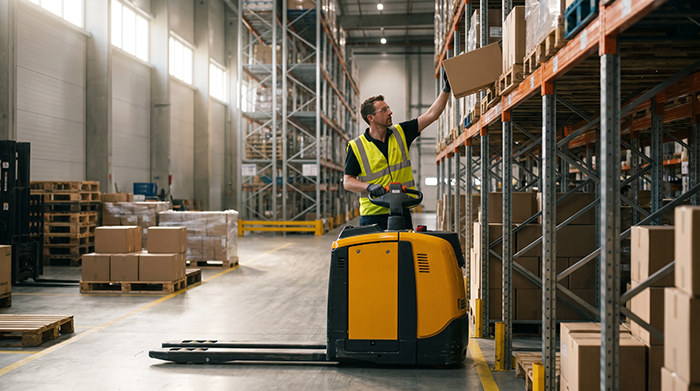
Numbers don’t lie, and when you run a genuine total cost of ownership (TCO) comparison, the case for electric stackers becomes almost impossible to argue against. The CZD-20’s impressive engineering profile — covered in the previous section — only tells half the story. The other half lives in your operating budget.
Diesel equipment carries a deceptively low sticker price that quietly balloons over time. Fuel alone tells the story: running a diesel forklift costs roughly $18–$25 per shift in fuel, while a lithium-ion charging cycle runs just $3–$5 per day — a difference that compounds fast across a full year of operations. According to ReliLift, electric forklifts reduce hourly operating expenses by 50% to 75% compared to diesel alternatives. That’s not a rounding error. That’s a budget transformation.
Switching from diesel to electric isn’t just an environmental choice — it’s one of the fastest ROI moves a warehouse manager can make in today’s cost environment.
The savings don’t stop at the charging station. Electric stackers typically require scheduled maintenance every 1,000 operating hours, compared to roughly 500 hours for diesel units. That means fewer service interruptions, less downtime, and lower labor costs for technicians. Diesel engines demand oil changes, filter replacements, and exhaust system checks — none of which apply to an electric drivetrain. Sourcing forklift parts for diesel equipment also adds unpredictability to your maintenance budget, especially when supply chains tighten.
| Metric | Electric Stacker | Diesel Forklift |
|---|---|---|
| Daily energy/fuel cost | $3–$5 | $18–$25 |
| Maintenance interval | ~1,000 hours | ~500 hours |
| Indoor emissions | Zero | Requires ventilation |
| Hourly operating cost | Up to 75% less | Baseline |
For facilities comparing options — including heavier conventional equipment — the long-term math consistently favors electric. And as the next section reveals, the battery powering that advantage is engineered to last far longer than most operators expect.
The TCO numbers covered in the previous section only tell part of the story. The real competitive edge of the CZD-20 lives inside its battery compartment — and it fundamentally changes how you think about forklift service over the long term.
Lithium-ion chemistry isn’t just cleaner than lead-acid — it’s dramatically tougher under daily warehouse punishment. According to Huaya Forklift and Flux Power, lithium-ion batteries deliver 3,000 to 5,000+ charge cycles, translating to up to 12 years of operational life under normal use.
Lead-acid batteries demand time and attention that most operations quietly absorb into overhead without realizing the true cost. Lithium-ion removes that burden almost entirely, freeing up technician hours for higher-value tasks.
Facilities running lithium-powered stackers indoors eliminate combustion emissions entirely — a measurable advantage for both air quality compliance and LEED certification goals.
With power reliability and environmental performance this strong, the natural next question becomes operational safety — and that’s exactly where the CZD-20’s design continues to impress.
The cost savings and battery longevity discussed in earlier sections only deliver real value when operators use equipment safely and confidently. OSHA-compliant training isn’t optional — it’s the foundation that protects workers, reduces liability, and keeps warehouse throughput moving without costly incident-related downtime.
“Properly trained forklift operators reduce workplace injuries by up to 70%, making structured certification programs one of the highest-return investments a facility manager can make.”
The CZD-20’s built-in safety architecture supports that training foundation from day one. Key protective features include:
CZD-20 Safety Feature Checklist:
Smaller equipment footprints aren’t just a space efficiency win — they directly reduce blind-spot incidents that contribute to most warehouse floor accidents. In practice, a stand-on stacker’s elevated operator position combined with its narrow profile creates significantly better forward visibility than traditional sit-down alternatives.
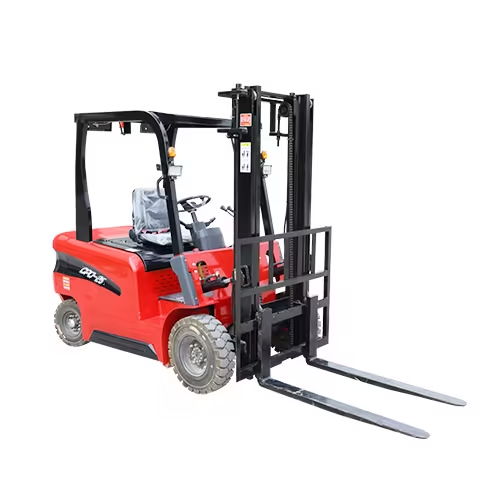
It’s also worth noting that electric models like the CZD-20 reach maintenance intervals exceeding 1,000 working hours, compared to roughly 500 hours for standard internal combustion forklifts. Fewer mechanical disruptions mean safer, more predictable equipment behavior over time.
“Integrating stacker-specific training modules into your existing facility safety protocols — rather than treating them as standalone certifications — dramatically improves compliance retention across the workforce.”
When searching for a qualified forklift dealer near me, prioritize partners who bundle operator training and safety documentation with equipment delivery. That end-to-end support model is actually a strong signal of a manufacturer’s long-term commitment — which connects directly to how smart procurement decisions get made.
Selecting the right equipment is only half the battle — choosing the right manufacturing partner determines whether your operation scales smoothly or stalls at the first obstacle. For global logistics firms and industrial park operators, one-stop procurement eliminates the friction of managing multiple vendors, shipping timelines, and incompatible support contracts.
Varyon has built its reputation on exactly that model: cost-effective, customized machinery solutions delivered through a single, accountable channel. Rather than piecing together equipment from scattered suppliers, procurement teams gain a unified catalog covering everything from walkie-stacker variants to heavy-duty counterbalance electric forklifts — all engineered to consistent quality standards.
Customization is where the partnership model genuinely pays off. Industrial parks carry unique constraints: ceiling heights, floor load ratings, aisle configurations, and cold-storage requirements that off-the-shelf equipment often can’t satisfy. Varyon’s engineering team works directly with facility managers to spec each electric stacker to those exact parameters before production begins.
After-sales infrastructure matters just as much as the initial purchase. Varyon provides 24/7 technical support, ensuring that a mechanical question at 2:00 AM doesn’t translate into a halted shift by 6:00 AM. That response capability is increasingly why global logistics firms are gravitating toward the VY-CPD series — not just for the hardware, but for the partnership behind it.
If you’re evaluating procurement options and still have open questions about specifications, operational range, or application fit, the next section addresses the most common queries directly.
How long does the CZD-20 battery last on a single charge?
Most operators see a full shift of 6–8 hours on a single charge under standard warehouse conditions. Heavier loads and frequent lifting cycles will reduce runtime, so having a spare battery or opportunity-charging station on hand is a practical safeguard for high-throughput environments.
Can I use a stand-on stacker outdoors?
Electric stackers are optimized for smooth, hard indoor surfaces. Uneven pavement, gravel, or wet conditions can strain the drive system and compromise stability. For occasional outdoor use on level, sealed concrete, check your model’s ingress protection rating first.
What is the difference between a stacker and a counterbalance forklift?
A stacker uses extended legs to counterbalance the load, making it ideal for narrow aisles and high-density racking. A counterbalance forklift relies on rear-end weight, requiring significantly more turning radius and open floor space.
How do I find parts for Varyon equipment?
Contact Varyon’s support team directly through their official website. Having your model number and serial number ready speeds up the process considerably.
Why do electric stackers have lower maintenance costs?
Electric models carry approximately 50% fewer moving parts than internal combustion engines, eliminating oil changes, filters, and exhaust components — a direct, ongoing reduction in service costs.