Get in touch
* Your personal information is securely protected and will only be used for business communication purposes.

Warehouse square footage costs more than ever, and every inch of unused aisle space is money walking out the door. As e-commerce timelines compress and consumer expectations tighten, the facilities that thrive are the ones that store more, move faster, and waste less floor space doing it. That’s not a goal traditional forklifts were designed to meet.
The shift toward high-density storage and micro-fulfillment centers has fundamentally changed what “efficient” means on a warehouse floor. According to the Peerless Research Group’s findings, the push toward micro-fulfillment requires material handling equipment that can navigate aisles narrower than 10 feet while maintaining high lift capacities. Traditional counterbalanced forklifts, built for open yards and wide corridors, simply can’t answer that call without sacrificing either speed or safety.
“Bigger” stopped being “better” the moment warehouse operators realized that a machine requiring a 12-foot aisle was costing them dozens of pallet positions per bay — and thousands of dollars in lost storage potential every year.
This is where the electric walkie stacker enters the conversation — not as a budget alternative to a forklift, but as a precision instrument purpose-built for high-density environments. Operators who’ve explored how equipment choice reshapes layout efficiency understand that aisle width directly dictates storage capacity, and storage capacity directly dictates ROI. Shaving even 18 inches off a working aisle can unlock row upon row of additional racking.
The stacker isn’t a compromise. It’s a calculated upgrade — and understanding which type fits your operation is where the real competitive edge begins.
Not all stackers are built for the same job. Choosing the wrong unit for your facility layout doesn’t just slow operations—it creates safety risks and leaves real efficiency gains on the table. Understanding the core categories helps procurement managers match industrial pallet stacker lift capacity requirements to the right machine from day one.
| Stacker Type | Best Use Case | Key Advantage |
|---|---|---|
| Electric Walkie Stacker | Narrow aisles, medium-frequency tasks | Compact footprint, zero emissions |
| Heavy Duty Electric Reach Stacker | High-bay racking, heavy loads | Extended reach with load stability |
| Counterbalanced Stacker | Open floor areas, no racking support needed | Versatile, no straddle legs required |
| Straddle Stacker | Standard pallet sizes, tight spaces | Improved stability at height |
| Manual / Semi-Electric | Low-frequency, light-duty tasks | Low upfront cost |
The electric walkie stacker is the workhorse of modern high-density warehousing. Operators walk behind or beside the unit, guiding it through aisles that a traditional forklift simply couldn’t navigate. In practice, these machines handle loads up to 3,000 lbs. and reach heights that make full use of vertical storage—turning wasted airspace into productive inventory locations. According to research on electric stacker adoption, their lower energy consumption and reduced maintenance burden make them a compelling long-term investment for operations running multiple shifts.
When load weight climbs and rack heights push past 20 feet, a standard walkie unit won’t cut it. Heavy duty electric reach stackers extend the mast forward, allowing operators to place pallets deep into racking bays without repositioning the entire machine. The result is faster cycle times and more precise placement—critical when you’re working with dense, multi-level rack configurations. For facilities exploring customized handling solutions, reach stacker specs can often be tailored to specific aisle widths and ceiling clearances.
Counterbalanced stackers use rear-mounted ballast to stabilize loads, making them ideal for open floor areas where straddle legs would be impractical. Straddle stackers, on the other hand, straddle the pallet using outrigger legs, distributing weight more evenly and improving stability at height. One practical approach is to deploy straddle units for standard EUR and GMA pallets in racked environments, while reserving counterbalanced models for loading docks or floor-level staging areas.
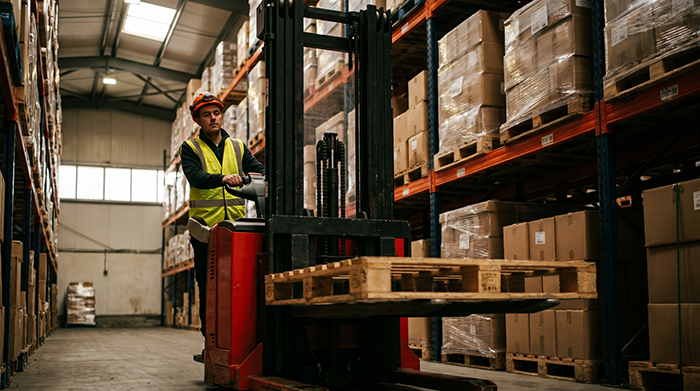
For operations with occasional light-duty needs, manual and semi-electric stackers offer a cost-effective entry point. Semi-electric units power the lift mechanism electrically while the operator pushes manually—reducing physical strain without the full investment of an all-electric model. However, these units aren’t designed for sustained high-throughput environments.
The right category decision has a direct impact on more than just productivity—it shapes your energy consumption and maintenance costs over the equipment’s entire lifespan, a point worth exploring in detail.
The case for switching to electric stackers isn’t just operational—it’s financial. Once decision-makers look beyond the sticker price and examine total cost of ownership (TCO), the numbers consistently favor electric over internal combustion (IC) alternatives. Understanding this equation is also central to figuring out how to choose the right stacker for small warehouses, where every dollar of overhead carries more weight.
Direct energy costs are the most immediate place to feel the difference. IC forklifts burn through propane or diesel continuously, with fuel prices subject to market volatility and storage compliance costs. Electric stackers draw from the grid on a predictable, manageable schedule. According to the U.S. Department of Energy’s Alternative Fuels Data Center, electric stackers can reduce operational energy costs by 30% to 50% compared to internal combustion alternatives in indoor warehouse settings—a margin that compounds significantly across multi-shift operations.
ROI Spotlight: Electric stackers reduce indoor warehouse energy costs by up to 50% compared to IC forklifts, according to U.S. Department of Energy data—a savings figure that scales directly with operational hours.
Maintenance costs tell a similarly compelling story. Electric motors have far fewer moving parts than combustion engines—no oil changes, no fuel filters, no exhaust system maintenance. Add the elimination of fuel storage infrastructure (tanks, safety compliance, spill containment), and the hidden cost savings become substantial.
Modern lithium-ion units push the advantage further through opportunity charging—the ability to top off the battery during breaks or shift transitions without waiting for a full discharge cycle. This eliminates the need for spare battery banks and dedicated swap areas, freeing up valuable floor space.
Long-term, the ROI picture improves even more when units are matched precisely to specific workflows. Customized solutions aligned to your facility consistently outperform off-the-shelf deployments in both throughput and equipment longevity. It’s an investment that pays forward—and that investment becomes even more valuable when your team operates with confidence in a safe environment.
Operational efficiency and financial savings only matter if your team stays safe while achieving them. That’s a reality every facility lead understands—and it’s where precision electric stackers make a genuinely compelling case over traditional sit-down forklifts.
Improperly maintained lifting equipment accounts for approximately 25% of all warehouse-related industrial accidents, according to the Occupational Safety and Health Administration (OSHA). That’s a sobering number—and a preventable one.
Walkie stackers give operators a direct, unobstructed sightline along the travel path. Unlike sit-down forklifts, where the mast and load frequently block forward visibility, walkie-style designs position the operator beside or behind the unit. In tight, high-density aisles, that difference isn’t minor—it’s the gap between a near-miss and an incident report.
Modern stackers—particularly a heavy duty electric reach stacker configured for demanding environments—incorporate automatic speed reduction when the mast is elevated and sensors that monitor load stability during travel. These aren’t luxury features; they’re engineered safeguards that compensate for the human errors that inevitably occur during high-volume shifts.
Key safety features typically include:
Preventative maintenance programs—often supported through global after-sales networks—keep these safety systems functioning as designed. Ergonomic controls reduce operator fatigue across long shifts, which directly lowers error rates. Most manufacturers also offer structured training protocols to bring new operators up to standard quickly.
Selecting the right unit amplifies every one of these safety advantages—which is exactly what the next section will walk you through.
Understanding why use an electric stacker instead of a forklift is only half the battle—the other half is selecting the right unit for your specific operation. A poorly matched stacker creates bottlenecks just as surely as the wrong tool does. Work through these four steps before you commit to a purchase.
Start with your floor plan. Grab a tape measure and document every aisle, corner, and pinch point in your facility. Modern VNA (Very Narrow Aisle) stackers can operate in spaces as tight as 1.6 meters while lifting up to 1.5 tons—a capability no standard counterbalance forklift can match. If your aisles run narrower than 2.5 meters, a reach stacker or VNA model almost certainly outperforms a conventional alternative.
Pro-Tip: Map your tightest turn first. That single constraint often determines your entire equipment class.
Never size a stacker to your maximum load alone. Calculate your average daily load weight, then add a 20–25% safety buffer before comparing rated capacities. Oversizing costs more upfront; undersizing creates safety risks and accelerates wear.
Pro-Tip: Request the load capacity chart from your supplier—capacity typically decreases as lift height increases.
Higher racking unlocks dramatically more cubic storage, but only if your equipment can reach it reliably. Measure your highest rack beam, then confirm the stacker’s free-lift height clears your facility’s sprinkler systems and overhead obstructions.
Pro-Tip: Account for floor-level variance—uneven concrete can reduce effective working height.
Lithium-ion batteries support opportunity charging during breaks, making them ideal for multi-shift operations. Lead-acid options cost less upfront but require dedicated charging time and ventilated spaces. Match the battery chemistry to your actual shift structure, not your ideal one.
Pro-Tip: If you run two or more shifts daily, lithium-ion’s faster recharge cycle typically delivers a positive ROI within 18–24 months.
With these four parameters locked in, you’re ready to move from spreadsheet to showroom floor—and in the next section, we’ll put theory into practice with a visual look at electric stackers navigating real-world warehouse scenarios.
[INSERT YOUTUBE VIDEO: Semi-Electric Straddle Stackers / Electric Walkie Operation]
Watch how pallet stackers navigate tight warehouse aisles with minimal clearance, and see proper loading technique demonstrated step by step — two skills that directly reduce product damage and operator strain.
Seeing the equipment move tells you more than specs ever could. In practice, what stands out immediately is how confidently these machines handle narrow-aisle environments — turning, positioning, and lifting without the wide swing radius that makes full-size forklifts impractical in high-density layouts. Proper load engagement matters equally: operators approach pallets squarely, confirm fork depth before lifting, and raise loads only after stabilizing the base. Correct technique isn’t optional — it’s what separates efficient operations from costly incidents. As you evaluate your own floor plan and workflow demands, the right equipment partner becomes the next critical decision.
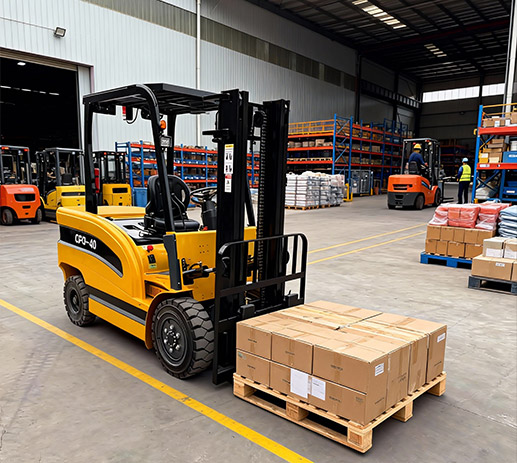
Selecting the right equipment is only part of the equation. Equally important is choosing a manufacturing partner that can grow alongside your operation—and deliver reliable support long after the purchase order is signed.
Varyon Power brings over a decade of focused expertise in high-performance material handling, combining engineering depth with the production capacity to back it up. A 200,000 m² manufacturing facility isn’t just an impressive number—it’s a direct indicator of export reliability, consistent component sourcing, and the ability to fulfill large-scale orders without lead-time surprises.
What sets this approach apart is genuine scenario-based customization. Industrial parks, cold-storage facilities, and multi-level mezzanine operations each present unique spatial and load-cycle demands. Rather than offering a one-size catalog, Varyon Power engineers configure electric stackers to match your exact racking layout, floor conditions, and throughput targets—making it a practical one-stop procurement solution for global buyers.
A reliable supply chain partner reduces fleet downtime far more effectively than reactive repairs ever could.
That philosophy extends into after-sales care. Around-the-clock technical support functions as a genuine risk mitigation strategy, keeping operations moving whether an issue surfaces on a Tuesday afternoon or a Saturday night.
For operations considering a walkie stacker or a heavier-duty counterbalanced model, connecting with the Varyon sales team is the logical next step. Still have questions before committing? The next section addresses the most common ones buyers ask before pulling the trigger.
What is the difference between a stacker and a reach truck?
A pallet stacker is a compact, pedestrian-operated machine designed for lower lift heights and tighter aisles, typically in smaller or medium-density operations. A reach truck is a ride-on, counterbalanced machine built for higher racking systems — often exceeding 30 feet — in large distribution centers. Stackers cost less, require less aisle space, and are easier to deploy quickly, making them ideal for operations that don’t need the full capability of a reach truck.
Can an electric stacker be used outdoors?
Most electric walkie stackers are engineered for smooth, indoor surfaces like sealed concrete. Using them outdoors on uneven pavement or gravel can stress the drive system and reduce stability. Some heavy-duty models offer wider wheelbases and all-terrain tires for limited outdoor use — but always verify the manufacturer’s IP rating and surface specifications before operating outside.
How long does a lithium-ion stacker battery last on a single charge?
In practice, a lithium-ion battery pack on a modern electric stacker delivers 6–8 hours of continuous operation under standard load conditions. Opportunity charging during breaks can extend effective uptime across a full shift without battery swaps. According to The Environmental Blog, lithium-ion technology also significantly reduces long-term energy and maintenance costs compared to lead-acid alternatives.
Do I need a special license to operate a walkie stacker?
No formal government-issued license is required in most U.S. states. However, OSHA mandates that all powered industrial truck operators — including walkie stacker users — complete employer-provided safety training and certification before operating equipment independently. Proper certification protects both the operator and the business from liability.