Get in touch
* Your personal information is securely protected and will only be used for business communication purposes.

Every diesel or LPG forklift running in your warehouse today carries a cost you might not see on a single invoice — but one that quietly accumulates across every oil change, spark plug replacement, emissions system service, and unplanned breakdown. These recurring expenses represent a genuine “maintenance tax” on your operations, and for many logistics managers, it’s finally becoming unsustainable.
Electric forklifts carry maintenance costs up to 50% lower than their internal combustion counterparts — a saving that compounds dramatically across a multi-vehicle fleet over a standard asset lifecycle.
Regulatory pressure is accelerating the shift just as sharply as the economics. Indoor air quality standards are tightening across U.S. distribution centers, with zero-emission zone policies expanding in states like California. Diesel and LPG equipment simply can’t meet those thresholds without costly retrofitting.
The financial tipping point is arriving sooner than many operators expect. When you factor in reduced fuel spend, fewer scheduled service intervals, and the lower total energy cost that lithium-ion technology enables, electric ROI routinely overtakes IC operational costs well within a standard five-year ownership window. According to Linde Material Handling, switching to electric can also eliminate up to five tonnes of carbon emissions per vehicle annually.
That’s precisely the operating environment the counterbalance electric forklift was engineered for — and where the VY-CPD25 sets a compelling new benchmark.
As warehouses move away from the hidden costs of internal combustion equipment, the question quickly becomes: which electric forklift for warehouse operations can actually handle the demands of serious logistics work? The VY-CPD25 answers that question with a combination of raw capability and refined engineering.
Rated at 2.5 tons of lifting capacity, the VY-CPD25 sits at a genuinely strategic point in the forklift market. It’s heavy-duty enough to handle palletized loads, dense inventory stacks, and bulk materials — yet maneuverable enough to operate efficiently within the tighter confines of modern distribution facilities. The 2.5-ton segment consistently represents the sweet spot for medium-to-heavy logistics: enough muscle for demanding applications without the footprint penalty of larger industrial machines.
The counterbalance design is central to what makes this machine dependable in high-reach environments. By distributing load weight against a rear counterweight, the VY-CPD25 maintains stability as lift height increases — a critical factor in rack-intensive warehouses where operators regularly work at elevation. Unlike narrow-aisle alternatives that require specific floor conditions or specialized aisle configurations, the counterbalance layout allows confident, unrestricted movement across standard warehouse floors.
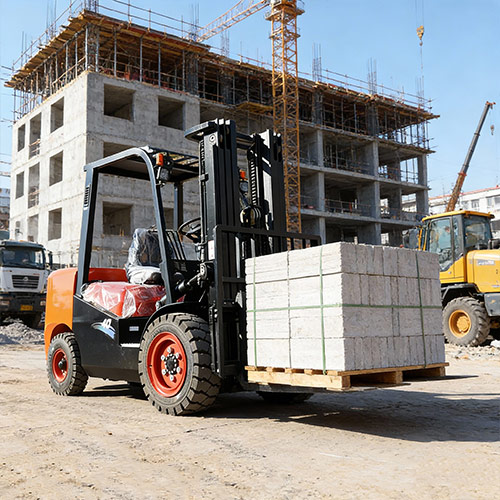
The engineering focus doesn’t stop at capacity. Precision hydraulic control allows operators to place loads accurately without overcorrection, reducing product damage and improving cycle times. The ergonomic operator cabin supports extended shift comfort — adjustable seating, intuitive controls, and clear sightlines all contribute to reduced operator fatigue and fewer handling errors over the course of a full workday.
What emerges is a machine designed as a purpose-built counterbalance unit for high-intensity environments — one built not just to lift, but to perform consistently across every shift. That consistency becomes even more compelling when paired with the right power system, which is exactly where lithium-ion technology changes the equation entirely.
| Capacity | Stability | Control |
|---|---|---|
| 2.5-ton rated load capacity for medium-to-heavy freight | Counterbalance design maintains stability at height | Precision hydraulic system for accurate load placement |
| Handles dense palletized inventory and bulk materials | Performs on standard warehouse floors without aisle modifications | Ergonomic cabin reduces operator fatigue on extended shifts |
| Sweet spot between light-duty and heavy industrial lifting | Engineered weight distribution eliminates tip-risk under load | Intuitive controls minimize handling errors and product damage |
The VY-CPD25 Electric Forklift doesn’t just swap out an engine for a battery — it rethinks what a power source should do across a full working day. That distinction matters enormously once you move beyond single-shift operations.
Traditional lead-acid batteries demand dedicated charging windows of 8 hours or more, plus an equal cooling period. Lithium-ion changes the equation entirely. Opportunity charging allows operators to plug in during scheduled breaks — lunch, shift handovers, routine pauses — and recover meaningful capacity in as little as 1–2 hours. No waiting. No production gaps.
Lead-acid batteries are notorious for voltage sag: as charge depletes, lift speed and responsiveness decline noticeably. Lithium-ion technology delivers consistent voltage throughout the discharge cycle, meaning the forklift performs the same in hour eight as it did in hour one. According to Hy-Tek / HELI, lithium-ion batteries maintain consistent voltage and can deliver up to 50% energy savings compared to lead-acid alternatives.
⚡ Charging Advantage: Lithium-ion reaches operational charge in 1–2 hours vs. 8+ hours for lead-acid — eliminating costly battery swap programs entirely.
| Feature | Lithium-Ion | Lead-Acid |
|---|---|---|
| Charge time | 1–2 hours | 8–10 hours |
| Cooling period required | No | Yes (8 hours) |
| Dedicated battery room | Not needed | Required |
| Energy efficiency | Up to 50% savings | Baseline |
| Voltage consistency | Stable throughout | Degrades with charge |
Lead-acid fleets typically require a dedicated battery room — ventilated space for charging, cooling, and swapping heavy battery packs. That’s square footage your warehouse could use for racking, staging, or throughput. Lithium-ion eliminates that infrastructure cost entirely.
That operational flexibility becomes especially critical when the environment itself creates additional demands — which is exactly where the VY-CPD25’s versatility across different applications comes into sharp focus.
Power and efficiency mean little without real-world adaptability. As a true battery electric forklift, the VY-CPD25 is engineered to perform across demanding environments where lesser equipment compromises productivity or safety.
Adaptable across environments, the VY-CPD25 doesn’t ask facilities to compromise between capability and compliance. That kind of operational flexibility naturally raises an important follow-up question: what does this equipment actually cost to own over time?
Versatility and performance are compelling, but procurement decisions ultimately come down to numbers. Shifting to a battery electric forklift like the VY-CPD25 isn’t just an operational upgrade — it’s a financial strategy with a measurable payback window.
Diesel and LPG prices fluctuate unpredictably, leaving fleet managers exposed to budget volatility. Electricity costs, by contrast, are far more stable and consistently lower per operating hour. In practice, a single 2.5-ton forklift running two shifts daily can generate thousands of dollars in annual fuel savings alone — savings that accelerate as energy prices climb.
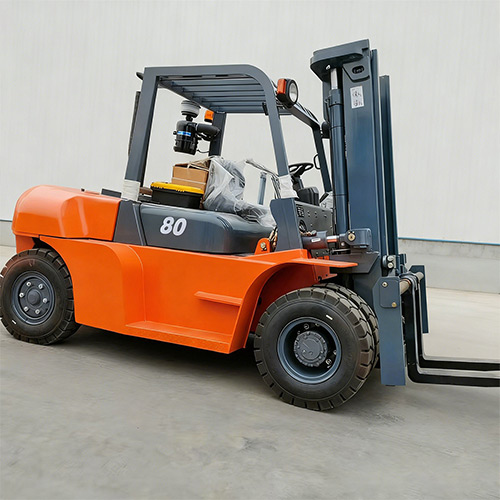
The upfront 3 ton forklift price comparison often draws initial hesitation, but a full TCO analysis tells a different story. When fuel, maintenance, and downtime costs are factored in, electric forklifts can reduce total cost of ownership by up to 45% compared to diesel models. Consider this breakdown:
Bottom line: Most operations achieve full ROI on the VY-CPD25 within 24 months of deployment.
Beyond the payback period, the VY-CPD25 continues building value. Lithium battery packs maintain consistent performance across thousands of cycles, protecting the asset’s residual value longer than lead-acid or combustion alternatives.
The economics are clear — and the manufacturer behind the technology matters just as much as the machine itself, a topic worth exploring in depth.
The case for the VY-CPD25 extends beyond its specifications. Choosing the right manufacturing partner is equally critical — and Chinese electric forklift manufacturers have undergone a fundamental transformation. What began as a cost-driven advantage has evolved into genuine technological leadership, particularly in lithium-ion battery integration and industrial vehicle engineering.
Today’s leading Chinese manufacturers don’t simply assemble components. They develop proprietary battery management systems, conduct rigorous lifecycle testing, and hold certifications that meet international safety standards. For operations requiring a capable 3 ton electric forklift, this translates into a product backed by serious engineering depth.
Partnering with Varyon Power means access to:
A manufacturer that controls its own supply chain, battery chemistry, and software stack delivers something no distributor can match: accountability at every level.
The VY-CPD25 represents where modern warehousing is headed — quieter, cleaner, smarter, and more cost-effective. Partnering with Varyon Power means you’re not just buying a forklift; you’re investing in a platform built to evolve with your operation.