Get in touch
* Your personal information is securely protected and will only be used for business communication purposes.

The electric forklift is no longer a niche alternative — it’s the new standard for modern material handling. What began as an emissions-friendly option for indoor cold storage has rapidly matured into the dominant solution across warehousing, distribution, and manufacturing environments worldwide.
The numbers confirm this shift decisively. According to Fortune Business Insights, the global electric forklift market is projected to grow from $56.33 billion in 2023 to $118.91 billion by 2030 — more than doubling in under a decade. That trajectory isn’t driven by regulation alone; it reflects a fundamental rethink of operational efficiency, fuel costs, and indoor air quality standards.
Within this expanding market, the 3.5-ton counterbalance configuration has emerged as the clear versatility sweet spot. It’s heavy enough to handle pallet loads, racking replenishment, and trailer unloading — yet compact enough to navigate tight warehouse aisles. In practice, this capacity range covers the widest share of daily logistics tasks without requiring specialized equipment or facility modifications.
Diesel still holds ground in heavy outdoor applications, but that window is narrowing fast. Understanding exactly why electric solutions are winning — and the technology behind them — starts with warehouse electrification trends reshaping fleet decisions right now. The terminology driving those decisions is worth knowing before going any further.
Understanding the vocabulary behind electric forklift technology is the foundation for making smarter fleet decisions. Before evaluating whether an electric counterbalance forklift fits your operation, it helps to speak the language that fleet managers, engineers, and sustainability teams all share.
**AC Traction Motor**
An alternating current motor that delivers consistent, precise torque across varying load conditions — making it the driving force behind the efficiency gains [U.S. Department of Energy](https://www.energy.gov) attributes to modern electric forklifts over internal combustion models.
**Counterbalance**
The rear-weighted design that offsets the load placed on the forks, allowing a 3.5-ton machine to lift and carry heavy pallets without tipping — no outriggers required.
**TCO (Total Cost of Ownership)**
A financial metric that accounts for purchase price, fuel or energy costs, maintenance, and downtime — the number that consistently favors electric over diesel when you [run the full ownership math](https://varyonpower.com/the-vertical-revolution-why-your-next-forklift-shouldnt-be-a-forklift.html).
**ESG (Environmental, Social, and Governance)**
A reporting framework that logistics companies increasingly use to measure sustainability commitments, where zero-emission equipment like electric forklifts directly improves scores.
TCO is the metric that quietly drives most fleet conversion decisions — because lower operating costs compound over a machine’s entire lifecycle. With these terms established, the next logical question becomes how electric performance actually holds up against diesel in head-to-head conditions.
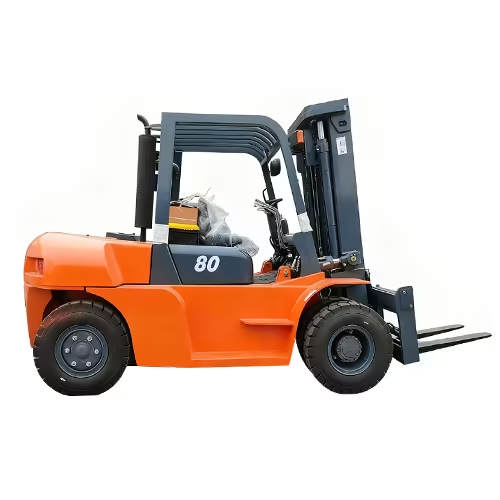
The battery electric forklift doesn’t just match diesel performance — in several measurable categories, it surpasses it. This is the claim that surprises most fleet managers hearing it for the first time, yet the operational data backs it up consistently.
Torque delivery is the clearest example. Electric motors produce peak torque instantly from zero RPM, meaning a 3.5-ton electric counterbalance accelerates smoothly and lifts responsively the moment an operator engages the controls. Diesel engines, by contrast, must build RPM before torque fully arrives — a lag that compounds across hundreds of load cycles per shift.
Noise reduction is equally significant. Diesel forklifts generate sustained engine noise that accumulates into measurable operator fatigue over a full shift. Electric units run near-silently, and as OSHA notes, the shift to electric material handling is “no longer just an environmental choice; it is a strategic operational imperative to reduce noise pollution.” Lower fatigue also means fewer operator errors over time.
Indoor air quality rounds out the comparison. Diesel exhaust requires costly ventilation infrastructure in enclosed warehouses — a hidden overhead that electric eliminates entirely.
| Metric | Electric | Diesel |
|---|---|---|
| Torque delivery | Instant | Delayed ramp-up |
| Noise level | Near-silent | High sustained noise |
| Indoor air quality | Zero emissions | Requires ventilation |
These operational advantages set the stage for a deeper look at how electric technology reshapes the long-term cost equation.
Switching to a warehouse electric forklift isn’t just a technical upgrade — it’s a financial decision that pays dividends across the entire equipment lifecycle. Once the performance case is established, the cost case becomes equally compelling.
According to U.S. Department of Energy, electric motors eliminate the need for oil changes, spark plugs, and timing belt replacements entirely. These aren’t minor savings — they represent a systematic removal of recurring service costs that compound over years of operation.
Maintenance tasks you can delete when going electric:
Energy costs follow the same logic. Charging electricity typically costs significantly less per operating hour than diesel fuel at current pump prices. As explored in a broader look at total ownership economics, that gap widens as fuel prices fluctuate.
Fewer moving parts also translate directly into longer equipment lifespan. With less mechanical wear accumulating over time, electric units routinely outlast their diesel counterparts in comparable duty cycles. However, battery health monitoring remains one area where operators should maintain diligence. That durability advantage ties naturally into a larger story — the environmental one — which the next section addresses head-on.
Electric forklift adoption has become one of the fastest, most measurable levers companies can pull to hit their net zero targets — and the numbers back that up.
Lifecycle carbon reductions are substantial. According to the Electric Power Research Institute (EPRI), electric forklifts can reduce CO₂ emissions by up to 54% over their lifecycle compared to diesel counterparts. For a warehouse running multiple shifts across a large fleet, that figure translates into thousands of tons of avoided emissions annually — the kind of progress that moves the needle on a corporate ESG scorecard.
Net zero mandates are no longer aspirational — they’re contractual. Retailers, third-party logistics providers, and global supply chain partners increasingly require emissions data from their vendors. Transitioning to electric material handling isn’t just an internal initiative; it’s a prerequisite for staying competitive in sustainability-driven procurement.
Every electric forklift manufacturer entering this space faces pressure to demonstrate real-world emissions accountability, not just specifications on paper. VARYON’s VY-CPD35 addresses this directly — engineered for high-capacity warehouse cycles while keeping emissions at zero at the point of use. Explore the full 3.5-ton electric range to see how it fits within a broader sustainable logistics chain.
Beyond emissions, though, the shift to electric also reshapes how operators interact with these machines — a dimension worth examining closely.
Electric forklifts don’t just move loads more cleanly — they’re engineered to move them more safely, with design choices that directly protect operators and bystanders.
Stability starts with physics. The battery pack in a high-capacity electric unit sits low in the chassis, creating a lower center of gravity than a diesel counterpart with its elevated engine block. The result is a more planted, predictable machine — especially critical when carrying a 3,500 kg load through a crowded dock. Units like the VY-CPD35 Electric Forklift are built around this principle, with balanced weight distribution that reduces tip risk on uneven flooring.
Precision matters just as much as stability. Electric motors respond instantaneously to throttle input, giving operators fine-grained control in tight warehouse aisles where a diesel engine’s lag can translate into costly contact damage. According to 2025 forklift industry trends, precision handling is increasingly cited as a top driver of electric adoption in high-density storage environments.
Operator health is where the ergonomic case becomes impossible to ignore. Electric drivetrains generate significantly less vibration than internal combustion engines, reducing cumulative stress on operators’ hands, wrists, and spines over an eight-hour shift. And because there’s no exhaust, OSHA data confirms that eliminating fumes directly improves air quality — cutting respiratory risks and lowering facility HVAC costs simultaneously.
Choosing the right unit starts long before the first shift — and that means evaluating the manufacturer behind the machine.
Choosing the wrong manufacturer costs more than the purchase price — it costs uptime, serviceability, and long-term ROI.
Not all electric forklifts are built to the same standard, and the gap between a well-engineered unit and a low-spec alternative becomes obvious fast in a demanding warehouse environment. Before committing to a supplier, ask these five questions:
A manufacturer that answers all five confidently is worth shortlisting. Varyon Power addresses these criteria directly through its high-capacity electric forklift lineup, including the VY-CPD35 — a 3,500 kg unit built for modern warehouse demands with lift heights ranging from 3 to 6 meters.
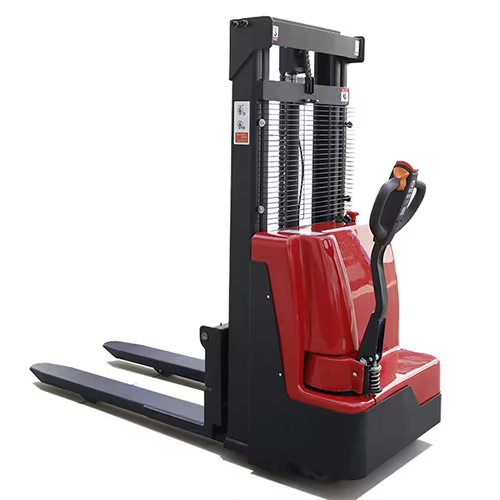
The next section puts that specific model to the test in real warehouse conditions.
Seeing a 3.5-ton electric counterbalance forklift perform in a real warehouse setting removes any doubt about whether electric can match diesel on the demanding metrics that matter most.
Video demonstrations circulating on platforms like YouTube and TikTok have become an increasingly valuable resource for fleet managers evaluating equipment. What those clips consistently reveal is a machine that handles full-load lifts, tight aisle navigation, and multi-shift operation without the noise or exhaust signature of an internal combustion unit.
[▶ Video Placeholder: VY-CPD35 Warehouse Demonstration — Watch for load stability at full 3,500 kg capacity, turning radius in standard racking aisles, and the near-silent operating profile during cycle runs.]
When watching footage of the VY-CPD35, look specifically for these performance indicators:
For operations managing factory-floor material flow, these visual benchmarks translate directly into productivity and compliance confidence. As the evidence stacks up across performance, safety, and manufacturer selection, the decision framework for fleet modernization becomes clearer than ever.
The electric 3.5-ton counterbalance forklift isn’t a niche alternative — it’s now the default choice for modern indoor material handling operations.
As covered throughout this article, the case for electrification rests on three mutually reinforcing pillars:
The question is no longer whether to electrify — it’s how quickly you can execute the transition.
Still have questions about battery runtime, outdoor use cases, or maintenance schedules? The next section addresses the most common practical concerns directly.
The right answers to common objections can accelerate your decision to modernize — here’s what fleet managers ask most.
How long does a 3.5-ton electric forklift battery last? A lithium-ion battery pack typically delivers 2,000–3,000 charge cycles before capacity degrades meaningfully. In practice, that translates to 7–10 years of daily single-shift operation. Opportunity charging during breaks extends runtime further without significant cycle penalty.
Can electric forklifts be used outdoors? Yes — with caveats. Industry standards confirm electric forklifts are increasingly capable in outdoor environments, though they perform best indoors where zero-emission benefits matter most. Hard terrain, wet weather, and wide temperature swings can affect battery efficiency, so verify an IP rating appropriate for your yard conditions.
What is the maintenance schedule for an AC traction motor? This is where electric shines. AC motors have no brushes, no carbon deposits, and no oil changes. A common pattern is a quarterly inspection covering motor mounts, contactor connections, and cooling vents — compared to the monthly filter, fluid, and spark plug checks a diesel requires.
Is total cost of ownership genuinely lower? Consistently, yes. Lower fuel costs, reduced maintenance labor, and fewer unplanned downtime events compound into significant savings over a five-year cycle.
The 3.5-ton electric counterbalance forklift isn’t the future — it’s the present. Evaluate your facility’s needs and take the next step toward a cleaner, more efficient fleet.