Get in touch
* Your personal information is securely protected and will only be used for business communication purposes.

Every hour a forklift sits idle for an unplanned engine service is an hour your operation bleeds money. Fuel costs, oil changes, filter replacements, and exhaust system maintenance aren’t line items — they’re recurring anchors dragging down warehouse profitability.
Internal combustion forklifts average $18–$25 in fuel per shift alone, and that’s before factoring in the compounding maintenance burden that diesel and LPG engines demand. Tighten that picture with increasingly strict indoor emission regulations — OSHA explicitly flags combustion engine exhaust as a serious hazard in enclosed spaces — and the pressure to switch becomes undeniable.
Still, one persistent myth stalls decision-makers: that electric forklifts can’t handle serious tonnage. The assumption that battery-powered machines are underpowered for 3.5-ton applications simply doesn’t hold up against modern engineering reality.
Electric alternatives are closing the gap fast. According to Fortune Business Insights, the global electric forklift market is projected to grow from $56.33 billion in 2023 to $118.91 billion by 2030 — a trajectory driven by performance, not just policy.
That’s precisely where the VY-CPD35 counterbalance electric forklift enters the picture: purpose-built to eliminate every compromise that once made heavy-duty electric operation feel like a trade-off. What that means for real-world performance deserves a closer look.
Where IC engines struggle with lag and warm-up cycles, the VY-CPD35 operates on fundamentally different physics. As Logistics Management Magazine notes, electric motors provide full torque immediately, offering smoother acceleration and more precise control in tight warehouse spaces. In practice, that means operators respond faster to load demands without the hesitation or throttle creep that slows IC-powered equipment.
A forklift that delivers full lifting force from the first inch of travel doesn’t just perform better — it changes how an entire warehouse floor is planned and used.
The VY-CPD35 maintains its full 3.5-ton lift capacity without compromising on maneuverability. Its tight turning radius allows navigation through narrow pick aisles where larger IC machines simply can’t operate efficiently. For facilities running high-density racking systems, this balance between raw capacity and spatial agility is a measurable competitive advantage. The shift toward lithium-based power systems has also allowed engineers to optimize weight distribution, improving both stability and control at full load.
The VY-CPD35’s chassis is engineered for heavy industrial applications — reinforced joints, a corrosion-resistant finish, and a frame geometry designed to handle repeated shock loads. Zero-emission operation also matters beyond compliance: removing exhaust from enclosed spaces directly reduces respiratory risks for your team.
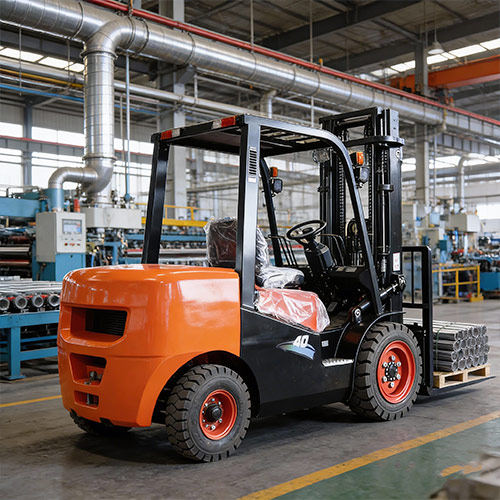
The real question, however, isn’t just how the VY-CPD35 performs on the floor today — it’s how its lithium ion forklift battery system eliminates the chronic downtime that lead-acid technology has always imposed. That’s where the operational math becomes impossible to ignore.
The VY-CPD35’s performance credentials, covered in the previous section, only tell part of the story. The electric forklift battery technology powering it is equally transformative — particularly for operations running two or three shifts.
| Feature | Lead-Acid | Lithium-Ion (VY-CPD35) |
|---|---|---|
| Full charge time | ~8 hours | 1–2 hours |
| Cooling period required | ~8 hours | None |
| Cycle life | ~1,000–1,500 cycles | 3,000+ cycles |
| Watering/maintenance | Regular | None |
| Battery room required | Yes | No |
According to Mitsubishi Logisnext Americas, lithium-ion powered forklifts reach a 100% state of charge in just 1 to 2 hours — compared to 8 hours of charging plus 8 hours of cooling for lead-acid systems.
Opportunity charging is where lithium-ion fundamentally changes shift planning. During lunch breaks, shift handovers, or loading pauses, the VY-CPD35 can top up its charge meaningfully — no full cycle required. What typically happens in lead-acid operations is that a spare battery bank sits waiting, consuming dedicated floor space just to keep the shift running.
Eliminating that dedicated battery room reclaims valuable warehouse real estate — space better used for inventory, staging, or throughput.
No acid watering. No equalization charges. No corrosion risk. Lithium-ion cells are sealed and self-managing, which removes a recurring labor cost that many operations underestimate. On the other hand, it’s worth noting that cold-environment performance remains a consideration for any battery chemistry.
The longer cycle life of lithium-ion isn’t just a spec sheet number — it’s a financial argument that becomes clearest when you examine total cost of ownership over a two-year horizon.
The upfront price of an electric warehouse forklift often draws scrutiny from procurement teams accustomed to IC equipment pricing. However, that comparison rarely survives a full TCO analysis. When sourced directly from an OEM/ODM manufacturer in China, the VY-CPD35 enters the market at a competitive acquisition cost — and then systematically eliminates the expense categories that erode IC fleet budgets year after year.
Maintenance savings alone reshape the math. According to Toyota Material Handling, electric forklifts carry fewer moving parts than IC engines, eliminating engine oil changes, filters, spark plug replacements, and exhaust system repairs entirely. In practice, this means fewer unplanned downtime events and lower labor costs per service interval — two factors that compound favorably over a multi-shift operational year.
Energy costs reinforce the case further. Electricity consistently runs at a fraction of the per-hour cost of LPG or diesel fuel, particularly relevant as gas prices remain volatile. Operators running two or three shifts can typically recover the price differential within 24 months. You can review the full equipment lineup to model these savings across fleet configurations.
ROI Callout: Electric forklifts from OEM-direct manufacturers typically deliver a payback period of less than two years — driven by eliminated fuel costs, reduced maintenance intervals, and longer battery service life with lithium-ion technology.
Battery longevity also contributes meaningfully to residual value. Lithium-ion packs in the VY-CPD35 are engineered for thousands of charge cycles before meaningful capacity degradation, sustaining asset value well beyond the payback window. These economic fundamentals hold across a surprisingly wide range of operating environments — which is exactly where the next section picks up.
Having established the VY-CPD35’s financial case, the equally compelling story is where this machine actually works—and that list is remarkably long.
Cold storage and food processing facilities demand clean operation above everything else. Unlike IC alternatives, the VY-CPD35 produces zero exhaust emissions, eliminating contamination risks in temperature-controlled environments. Its sealed components also resist moisture buildup common in refrigerated warehouses, keeping maintenance costs predictable.
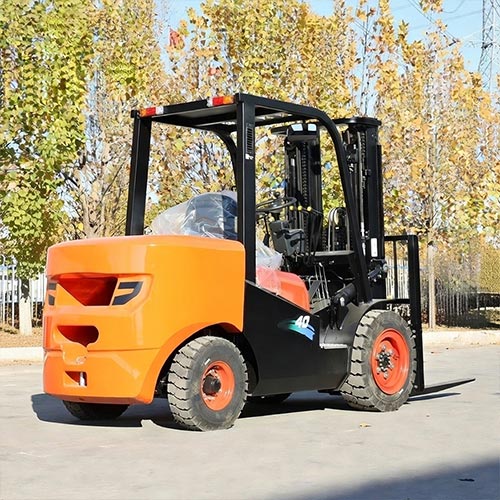
A 3 ton electric forklift with a tight turning radius transforms pallet density calculations. The VY-CPD35’s compact counterbalance design allows operators to navigate narrow aisles confidently, recovering floor space that wider equipment sacrifices. For high-throughput distribution centers, that recovered square footage directly translates to increased storage capacity.
Heavy manufacturing environments require consistent, repeatable lifting performance. The VY-CPD35 handles dense raw materials—steel coils, concrete components, bulk resin—with the same precision across an entire shift. Explore heavy-duty handling configurations if your operation involves demanding production-floor cycles.
According to Logistics Management Magazine, electric models are now fully capable of handling heavy-duty outdoor tasks previously reserved for diesel. The VY-CPD35’s IP-rated electrical components manage rain, dust, and temperature swings—making dock-to-floor transitions genuinely seamless.
These real-world applications naturally raise practical questions operators ask before committing to a purchase.
How long does a lithium-ion forklift battery last?
Lithium-ion batteries in industrial forklifts typically deliver 2,000–3,000 charge cycles before significant capacity degradation—translating to roughly 7–10 years of regular operational use. Opportunity charging between shifts further extends effective runtime without damaging battery health.
Can the VY-CPD35 be used outdoors in the rain?
The VY-CPD35 carries an IP rating suited for light outdoor exposure, including loading docks and covered yards where moisture is a factor. However, sustained heavy rain or full outdoor operation in harsh weather warrants additional review with your equipment supplier to confirm site-specific suitability.
What is the difference between OEM and ODM forklift manufacturing?
Working with OEM/ODM electric forklift manufacturers means buyers can either source a proven design under their own brand (OEM) or collaborate on custom-engineered specifications (ODM). This flexibility lets distributors and fleet operators align equipment precisely with operational demands rather than accepting off-the-shelf compromises.
How does the 3.5-ton capacity compare to 3-ton models in real-world use?
That extra 500 kg of rated capacity creates meaningful headroom when handling dense pallets, irregularly stacked loads, or heavier manufacturing components. Teams running lighter-capacity equipment often find the VY-CPD35 eliminates the need for a second, larger machine—consolidating fleet complexity and reducing total operating costs.