Get in touch
* Your personal information is securely protected and will only be used for business communication purposes.

The counterbalance electric forklift has crossed a tipping point — and the warehouses still running internal combustion engines are paying for it in ways that don’t always show up on a fuel invoice.
Indoor air quality regulations, tighter operating margins, and the relentless push toward high-density storage have converged into a single mandate: go electric or fall behind. As the Material Handling Institute (MHI) notes, “the shift toward electrification in material handling is no longer just about the environment; it is about the superior precision and indoor air quality required for modern high-density warehousing.”
The VY-CPD30 sits at the center of this shift — a 3-ton electric forklift engineered not as a compromise between performance and sustainability, but as proof that the trade-off no longer exists. For years, the industry framed the “green vs. efficiency” debate as an either/or choice. That framing is now obsolete.
Electric doesn’t mean underpowered. It means optimized.
In practice, fleets making the switch to electric are discovering measurable gains in uptime, operating costs, and spatial efficiency — benefits that warehouse electrification is accelerating across every sector of logistics.
Understanding why the VY-CPD30 delivers on all fronts starts with the language of the technology itself.
Understanding the technology behind modern electric forklifts separates informed buyers from operators who simply swap batteries and hope for the best.
Before evaluating any electric fleet investment, a shared vocabulary makes every specification sheet, vendor conversation, and ROI calculation sharper. Here are the four terms that matter most right now:
**AC Drive Motor**
The power unit that converts electrical energy into motion. According to the Warehouse Education and Research Council (WERC), AC drive motors deliver more consistent torque and superior speed control compared to traditional DC motors — and they enable regenerative braking without additional hardware.
**Counterbalance**
The engineering principle behind a forklift’s ability to lift heavy loads without tipping. Ballast weight built into the rear of the machine offsets the load at the forks, enabling safe 3-ton capacity lifts on a compact footprint.
**Regenerative Braking**
A process where kinetic energy produced during deceleration is converted back into electrical energy and fed into the electric forklift battery — extending runtime and reducing brake wear simultaneously.
**TCO (Total Cost of Ownership)**
The complete lifecycle cost of operating a forklift, covering purchase price, energy, maintenance, and downtime. As explored in detail on [high-density stacking alternatives](https://varyonpower.com/the-vertical-revolution-why-your-next-forklift-shouldnt-be-a-forklift.html), TCO tells a very different story than sticker price alone.
These four concepts form the analytical backbone of every smart electric fleet decision. And as the next section shows, they translate directly into measurable dollar savings across the full ownership cycle.
Switching to a warehouse electric forklift isn’t just an operational decision — it’s a long-term financial strategy that compounds savings across every year of the machine’s life.
According to the industry experts, electric forklifts can reduce total cost of ownership by up to significantly compared to internal combustion models over their lifespan. That figure becomes concrete when you break down where the savings actually accumulate:
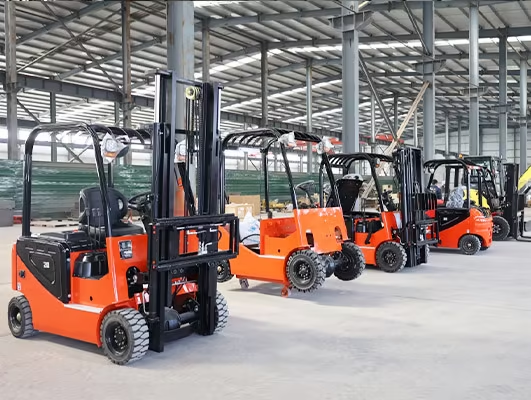
The practical result: operators report significant reductions in maintenance hours per unit, per year.
However, it’s worth acknowledging that upfront acquisition costs for electric models remain higher than entry-level combustion alternatives. The TCO advantage materializes over time — typically within 24 to 36 months — not at the point of purchase.
These savings set the stage for understanding exactly how the VY-CPD30 is engineered to maximize that value from the ground up.
The VY-CPD30’s hardware doesn’t just meet warehouse demands — it anticipates them, combining puncture-proof durability, a precision-matched lifting capacity, and operator-focused ergonomics into a single cohesive platform.
Solid tires are the foundation of that durability. Unlike pneumatic alternatives, solid tires eliminate the risk of punctures entirely — a critical advantage in environments where metal shavings, pallet debris, and uneven loading dock surfaces are routine hazards. In practice, this translates directly to less downtime and fewer maintenance calls, which compounds the TCO savings outlined in the previous section.
Lifting capacity is where the VY-CPD30 hits the sweet spot. Rated at 3-ton, it handles the overwhelming majority of standard warehouse loads without the overhead costs associated with heavy-duty equipment. That range covers palletized goods, racking replenishment, and cross-dock transfers — without overbuilding for edge cases most operations rarely encounter.
Ergonomic cabin design rounds out the engineering story. Adjustable seating, intuitive controls, and reduced vibration profiles lower operator fatigue across extended shifts — a factor any responsible electric forklift manufacturer must prioritize as warehouse labor retention becomes increasingly competitive.
What the VY-CPD30 delivers mechanically also has a broader dimension. Every engineering decision — from tire compound to cabin layout — carries a measurable environmental footprint, a point worth examining closely as fleet procurement standards tighten heading into 2026.
Electrification is no longer just a cost decision — it’s the clearest signal a logistics operation can send about its long-term environmental commitments.
The VY-CPD30 Electric Forklift delivers measurable ESG impact from day one. According to the U.S. Department of Energy, switching from internal combustion to electric forklifts reduces CO₂ emissions by approximately 10 to 15 tons per vehicle, per year. For a fleet of even ten units, that’s a documented reduction of up to 150 tons annually — figures that translate directly into sustainability reports and regulatory filings.
“The elimination of exhaust fumes and engine noise isn’t a comfort feature — it’s a compliance and productivity advantage that reshapes the entire indoor working environment.”
Beyond emissions, the benefits compound indoors. Diesel and LPG-powered alternatives generate both exhaust and significant noise pollution that degrades air quality and increases worker fatigue over long shifts. Electric operation produces neither. This matters increasingly as OSHA tightens indoor air quality standards and warehouse operators compete for skilled labor in a tight market.
For procurement teams building toward 2026–2030 carbon reduction targets, fleet electrification is one of the highest-leverage moves available. It’s also more nuanced than it first appears — the right electric platform must match the operational intensity of its environment. That’s precisely where uptime and energy management become the deciding factors.
Uptime is the ultimate currency in high-density logistics — and electric material handling solutions are winning the exchange rate against diesel in nearly every measurable category.
Modern electric forklifts like the VY-CPD30 close the uptime gap through two complementary systems working in tandem:
The result is a forklift that works with your shift schedule, not against it.
| Factor | Electric (VY-CPD30) | Diesel |
|---|---|---|
| Refuel/recharge time | Opportunity charging possible | Full tank stop required |
| Maintenance downtime | Lower (fewer moving parts) | Higher (fluid, filters, engine) |
| Indoor operational hours | Unrestricted | Ventilation-limited |
| Long-term uptime trend | Improving (smarter BMS) | Flat |
Forecasts from TCM’s 2026 Trend Analysis reinforce this shift: Li-ion forklifts are projected to grow from roughly 32% market share in 2024 to over 70% by 2034 — a trajectory driven largely by uptime reliability. The operational case for electric is no longer a projection; it’s a pattern already visible on warehouse floors.
These efficiency gains don’t exist in isolation. As explored with the VY-CPD30’s compact maneuvering advantages, a machine that runs longer also needs to operate safer in the tight corridors where that uptime matters most.
Electric forklifts aren’t just cleaner than diesel alternatives — they’re fundamentally safer by design, and the VY-CPD30 demonstrates this at every operational layer.
The shift from diesel to electric reshapes safety from the ground up — literally. The VY-CPD30’s battery pack sits low in the chassis, creating a lower center of gravity that directly improves stability during cornering and load elevation. This design principle reduces tip-over risk in ways that top-heavy combustion alternatives simply can’t replicate.
Key safety features working in concert:
Operator health is a safety metric too. Eliminating diesel exhaust removes chronic respiratory exposure, while reduced vibration across multi-hour shifts measurably lowers fatigue. Less fatigue means sharper attention — and sharper attention prevents incidents. For operations exploring purpose-built electric handling equipment, these compounding safety benefits represent meaningful long-term liability reduction, not just regulatory compliance.
With safety fundamentals established, the VY-CPD30’s real-world performance tells the complete story.
Seeing a machine perform under real conditions tells you more than any spec sheet ever could — and the VY-CPD30 delivers a compelling visual argument for electrification.
{{youtube: Efficient and Green – VY-CPD30 Electric Forklift Operations | Varyon Power YouTube}}
Maneuverability defines the machine’s competitive edge. The VY-CPD30’s compact turning radius allows operators to navigate tight warehouse aisles, loading docks, and multi-level racking systems with precision that bulkier alternatives simply can’t match. As covered in the safety and operational sections above, this isn’t incidental — it’s engineered into every dimension of the chassis.
In practice, logistics hubs running high-throughput SKU cycles benefit most visibly from the VY-CPD30’s real-world application. The combination of solid tire stability, responsive AC motor torque, and consistent lift capacity creates a machine that handles both repetitive pallet cycling and precision placement tasks without operator fatigue escalating across shifts. One practical pattern observed across dense distribution environments: cycle times drop measurably when operators aren’t compensating for equipment inconsistency.
For teams ready to move from observation to specification, detailed product configurations are available via New Battery Forklift CPD30 Electric Forklift with Solid Tires — a useful next step before evaluating the broader fleet implications ahead.
The VY-CPD30 isn’t just a forklift upgrade — it’s a strategic platform that positions high-density logistics operations for the demands of 2026 and beyond.
As this article has shown, the case for electrification goes far deeper than fuel savings. Here’s what every fleet decision-maker should carry forward:
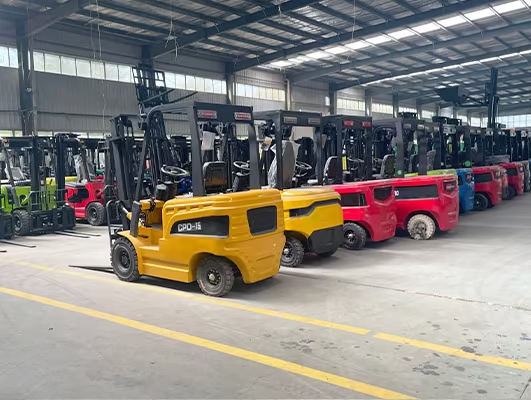
📋 Quick Reference: VY-CPD30 Core Advantages
- 75% TCO reduction over the machine’s operational lifespan makes the investment case undeniable against conventional alternatives
- AC motor technology paired with solid tires delivers heavy-duty reliability across punishing shift cycles without sacrificing precision
- Zero-emission operation directly supports ESG compliance targets and protects indoor air quality for warehouse teams
- Fleet electrification is a strategic necessity, not a preference — particularly for operations targeting carbon neutrality by 2030, a benchmark the VY-CPD30 is specifically engineered to support
The bottom line: high-density logistics in 2026 will reward operators who made the electric transition early. The VY-CPD30 bundles performance, safety, and sustainability into a single, proven platform that scales with operational ambition.
Still weighing the specifics? Questions about battery runtime, outdoor use, maintenance intervals, and head-to-head performance versus diesel are exactly what the next section addresses.
The right answers to the right questions separate confident purchasing decisions from costly mistakes — here’s what logistics managers ask most about the VY-CPD30 and electric counterbalance forklifts in general.
How long does the VY-CPD30 battery last on a single charge? In practice, the VY-CPD30 supports a full single-shift operation — typically 6 to 8 hours — on one charge. Opportunity charging during breaks can extend runtime across demanding double-shift environments without requiring a full battery swap.
Can electric forklifts be used outdoors? Yes, with important caveats. According to the OSHA Warehousing Safety Guide, modern electric forklifts equipped with solid tires can operate on flat outdoor surfaces — though they remain optimized for smooth indoor warehouse floors.
What is the maintenance schedule for an electric counterbalance forklift? Electric models eliminate engine oil changes, fuel filter replacements, and transmission servicing. A common pattern is quarterly inspections covering brake systems, battery health, and hydraulic fluid levels — significantly reducing total downtime compared to diesel alternatives.
How does the VY-CPD30 compare to diesel models on performance?Electric counterbalance forklifts offer competitive torque delivery at lift initiation — with zero emissions, lower noise output, and predictable energy costs. For high-density indoor logistics today, the performance gap has effectively closed.