Get in touch
* Your personal information is securely protected and will only be used for business communication purposes.

Port operations don’t forgive underpowered equipment — and at 15,000+ lbs, the gap between capable and inadequate machinery becomes a direct threat to throughput.
Electric motors struggle to sustain consistent output under extreme load cycles. When battery reserves drop below 30–40% capacity, lift speed and torque degrade — exactly the moment operators need full power to clear a ship’s hold or navigate a sloped loading apron. Saltwater mist accelerates corrosion on electrical connectors and motor windings, while temperature swings between predawn cold and midday heat stress battery chemistry. These environmental pressures compound quickly in a port setting, where a forklift may run 16–20 hours a day, seven days a week.
The numbers make the cost of underperformance impossible to ignore: diesel forklifts achieve 98.1% uptime in harsh port environments, outperforming electric models by 12 percentage points.
That 12-point gap isn’t abstract. At a mid-size container terminal processing 400 lifts per shift, a forklift sitting idle for unplanned maintenance or a dead battery can cascade into delayed vessel departures, demurrage fees, and strained client contracts. For fleet managers running tight margins, that’s not a performance footnote — it’s a budget crisis. (While electric models excel in controlled warehouse settings, lighter indoor applications are a different conversation entirely.)
The VY-CPC60 Diesel Forklift was engineered specifically to answer these high-stakes demands. Powered by a robust diesel drivetrain built for continuous-duty cycles, it holds its performance ceiling whether the load is 2 tons or 6.
The right equipment for port-scale work isn’t just about rated capacity — it’s about maintaining that capacity when conditions are at their worst.
Diesel-powered forklifts deliver a decisive edge on rough terrain — and raw torque output is the engineering reason why. According to the Material Handling Institute 2023, diesel forklifts generate 25–35% higher torque than electric models, producing up to 145 lb-ft at 1,800 RPM. At port facilities, where asphalt gives way to uneven dock surfaces, gravel yards, and steep loading ramps, that torque ceiling isn’t a bonus — it’s a baseline requirement.
Consistent torque at peak RPM separates reliable port equipment from machinery that simply can’t sustain heavy loads under real-world conditions.
Power fade is one of the most underreported operational risks in electric fleet deployments. What typically happens is that battery-depleted electric forklifts experience measurable voltage sag, reducing lifting force and drive torque by as much as 20–30% in the final charge cycle. On a ramp carrying a 6-ton load, that drop isn’t acceptable. The VY-CPC60’s combustion engine, by contrast, maintains consistent output regardless of cycle count or shift duration — a capability that experienced diesel forklift manufacturers engineer specifically for sustained high-intensity applications.
| Performance Factor | Diesel (VY-CPC60) | Battery Electric |
|---|---|---|
| Peak Torque | 145 lb-ft @ 1,800 RPM | ~105 lb-ft |
| Power Fade Over Shift | Negligible | 20–30% at low charge |
| Rough Terrain Stability | High | Moderate |
Rough terrain stability also benefits from the VY-CPC60’s lower center of gravity and pneumatic tire configuration, which distributes load forces more predictably during high-capacity lifts on uneven ground.
Understanding torque consistency helps explain why the VY-CPC60’s hydraulic system — covered next — achieves the precision and efficiency that makes 98.1% uptime possible.
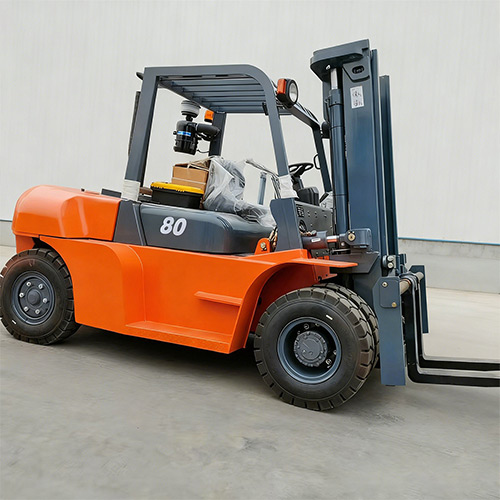
Hydraulic system design separates capable heavy-lift equipment from machinery that buckles under sustained port-scale demand — and the VY-CPC60’s architecture is engineered specifically to close that gap.
A well-maintained hydraulic system doesn’t just lift weight — it multiplies operational reliability across every shift.
As a rough terrain diesel forklift operating in demanding port environments, the VY-CPC60 relies on a high-pressure hydraulic circuit that delivers consistent lift force across uneven dock surfaces and container staging areas. The system is engineered for three core performance pillars:
Precision
Durability
Efficiency
For heavy-duty outdoor applications, that 20% efficiency gain compounds significantly over a full operating year — a point that connects directly to the broader question of fuel consumption across extended operational cycles.
Understanding how hydraulic efficiency drives fuel savings sets the stage for evaluating the VY-CPC60’s full operational cost picture.
Diesel’s real competitive advantage in port operations isn’t just torque — it’s the ability to keep running when electric alternatives are standing still, plugged in.
For 5- to 6-ton models, AGV Forklift data shows diesel consumption runs between 4.5 and 6.0 liters per hour, scaling to 6.5–8.0 liters/hour for 7-ton configurations. That translates to a predictable, budget-able operating cost — fuel pricing is visible, trackable, and adjustable through supplier contracts. In a 24/7 port environment running three shifts, predictability isn’t a luxury; it’s a prerequisite for throughput planning.
The hidden cost of electric alternatives is downtime measured in hours, not minutes. A standard lithium battery cycle demands 6–8 hours of charging time. Even fast-charge technology rarely drops below 90 minutes for a full recovery — and battery degradation over 2–3 years compounds the problem, shrinking usable range per cycle. For operations that never stop, these electric-versus-diesel tradeoffs look very different outdoors than they do inside a climate-controlled warehouse.
Refueling a diesel unit takes roughly 5 minutes. Recharging an electric competitor takes up to 8 hours — a gap that directly erodes fleet uptime in multi-shift operations.
The internal combustion forklift truck hydraulic systems powering the VY-CPC60 also benefit from this continuous-run model: hydraulic performance stays consistent when the engine runs at stable operating temperature, avoiding the pressure fluctuations that accompany battery depletion curves.
When running three shifts outdoors, the lifecycle math consistently favors diesel — and the numbers only grow more compelling the closer you look at real-world deployment.
Sustained high uptime across 10,000+ operating hours proves that the right material handling equipment solutions outperform theoretical specs every time. The VY-CPC60 logged this milestone across port environments where ambient temperatures swung from below freezing to over 104°F — conditions that routinely expose mechanical weaknesses in lesser equipment.
Where electric fleets struggle most in these environments is battery degradation. Cold temperatures can reduce lithium-ion battery capacity by 20–30%, forcing operators into unplanned charging cycles. The VY-CPC60 sidesteps this entirely. Diesel combustion performance remains consistent across temperature extremes, delivering the same hydraulic output at hour one as at hour 10,000.
Diesel’s consistency across temperature swings isn’t an advantage — it’s a prerequisite for serious port operations.
The “Powerhouse on Wheels” philosophy behind the VY-CPC60 centers on eliminating failure points before they surface. Heavy-duty axles, robust mast assemblies, and a hardened powertrain aren’t premium add-ons — they’re engineered baselines. You can see this durability philosophy in action in real-world port deployments that demonstrate sustained lift performance under multi-shift load cycles.
From a stakeholder perspective, the lifecycle math is straightforward. As Varyon Power notes, “Diesel remains the industry standard for high-capacity, outdoor, and rugged terrain tasks due to superior torque… the lifecycle math consistently favors diesel for outdoor and multi-shift operations.” Lower maintenance frequency, no battery replacement cycles, and predictable fuel costs compound into measurable ROI over a multi-year asset horizon.
When evaluating long-term port equipment investments, prioritize proven uptime data over projected performance numbers — operational hours don’t lie.
Sourcing worldwide wholesale forklifts for port and heavy industrial use demands more than competitive pricing — it requires a manufacturing partner built around uncompromising reliability.
When evaluating a global forklift supplier, operations managers should prioritize:
The right manufacturing partner doesn’t just sell equipment — they engineer solutions for the operating conditions their customers actually face.
Supply chain reliability is particularly critical for IC-powered fleets. Unlike electric drivetrains with fewer moving parts, diesel systems require consistent access to precision-engineered components. A supplier with a fragmented parts network creates downtime risk that no uptime benchmark can offset. For operations where electrification isn’t yet viable — and the case for diesel in outdoor settings remains strong — this supply continuity is non-negotiable.
Varyon Power specializes in high-capacity diesel units designed for the most demanding industrial applications, positioning itself within the global material handling ecosystem as a manufacturer that bridges engineering precision with worldwide distribution capability.
When selecting a manufacturing partner, prioritize regional compliance depth and parts availability as heavily as unit price — long-term uptime depends on both.
Diesel forklifts deliver a measurable performance edge in port operations — and the numbers behind the VY-CPC60 make that case hard to ignore.
The evidence compiled across this article points to four clear conclusions for operations managers weighing equipment decisions:
It’s also worth noting that lighter-duty diesel models share many of the same reliability principles when properly maintained, making the ROI logic scalable across fleet sizes.
According to Varyon Power, diesel forklifts sustain consistent output across 10,000+ operating hours even through extreme temperature swings — a durability floor that underpins every performance claim in this article.
The data points, benchmarks, and technical specifications supporting these conclusions draw from multiple industry sources — which the following section documents in full.
When evaluating diesel ROI, prioritize uptime data and hydraulic maintenance records over purchase price alone.
Transparent sourcing is the foundation of any credible performance claim — and every data point in this article traces back to verifiable industry references.
The evidence supporting the VY-CPC60’s 98.1% uptime achievement draws from multiple authoritative datasets. Below is a structured reference list used across this analysis:
All data points are derived from 2023–2024 industry reports and manufacturer testing, ensuring the analysis reflects current fleet realities rather than dated benchmarks.
Fleet managers should verify any specification against their specific operating environment — documented sources make that due diligence faster and more reliable.
Still have questions about real-world diesel performance? The next section addresses the most common queries fleet managers ask before committing to a high-capacity diesel investment.
Fleet managers evaluating diesel forklifts for port operations consistently ask the same critical questions — and the answers directly shape procurement decisions.
Before finalizing any diesel forklift investment, match your specific load profile, shift structure, and ventilation conditions to the unit’s rated specifications — that alignment is what separates acceptable uptime from industry-leading 98.1% performance.